Galentine's Day games printable pack
Eight games for a night with your people: 30 bingo cards, rom-com trivia with answers, friendship awards and cards that get everyone saying something nice.
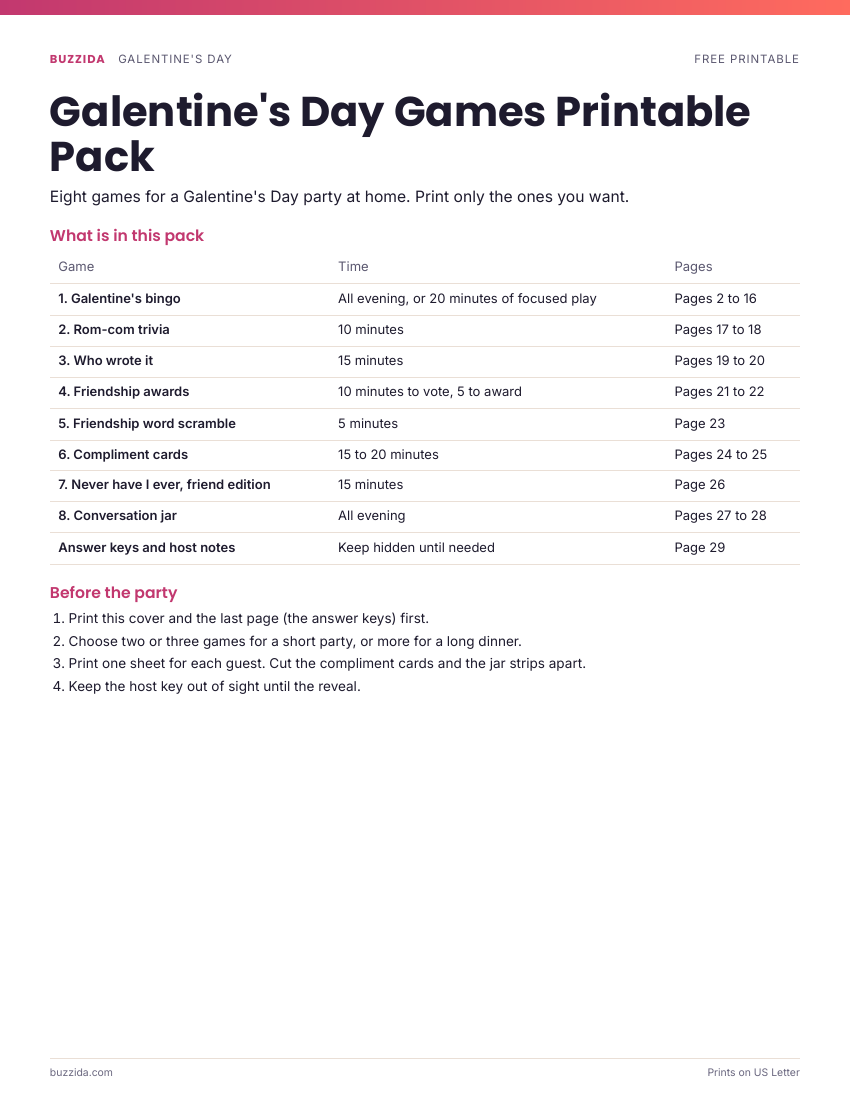
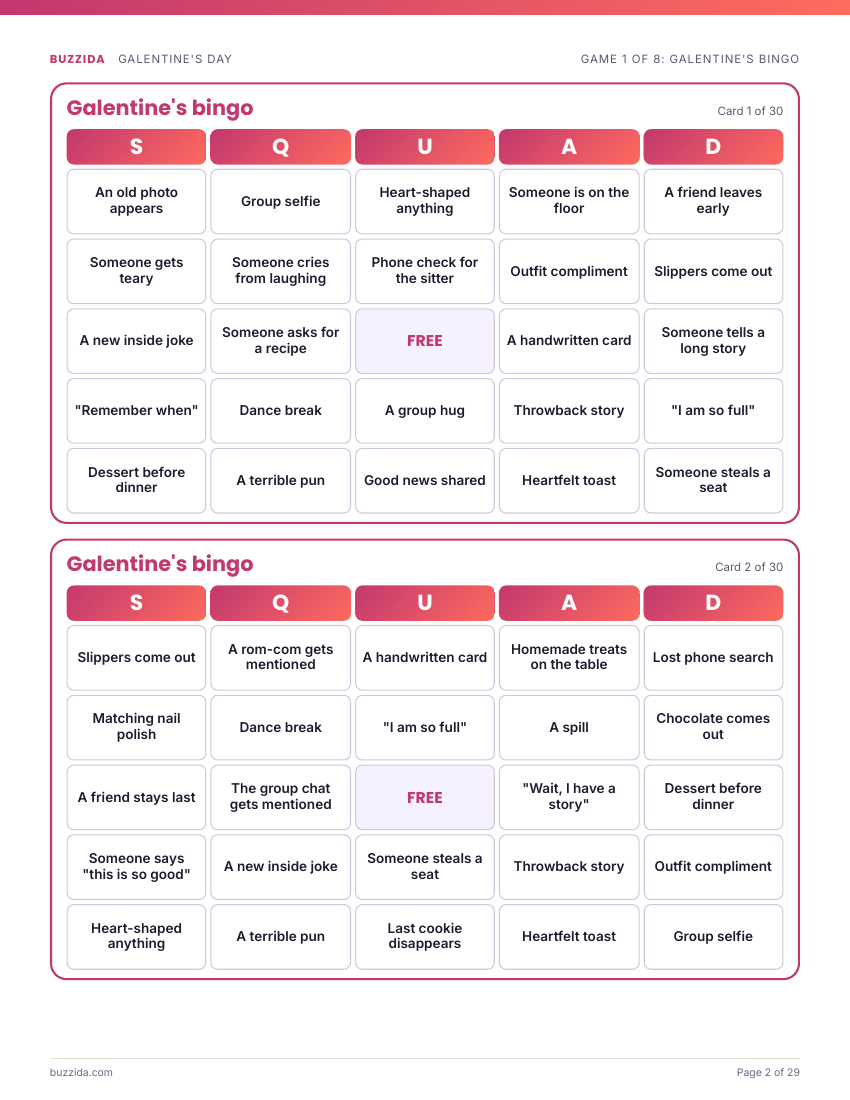
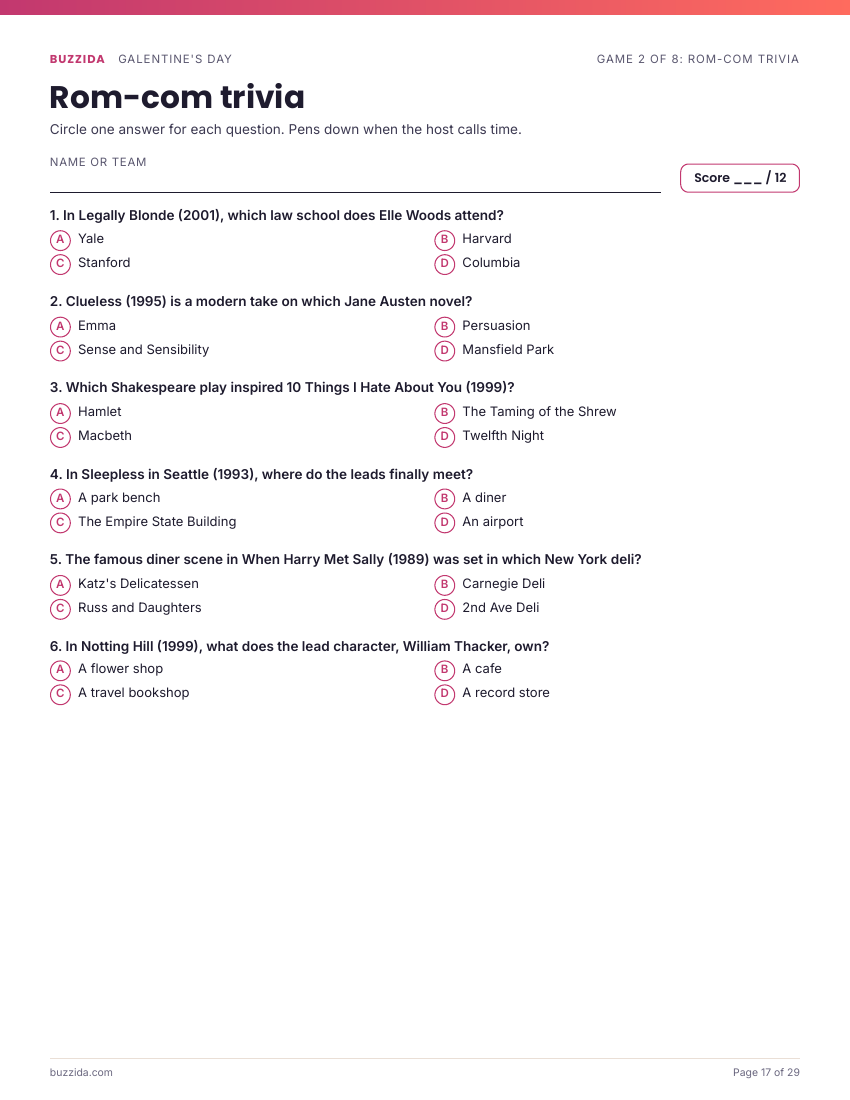
- 8 games
- 30 unique bingo cards
- US Letter PDF
- No alcohol needed
What is inside
- Galentine's bingo: 30 different cards, two to a page, from a pool of 48 squares
- Rom-com trivia: 12 multiple choice questions, with answers and sources
- Who wrote it: two slips per page plus a guess sheet
- Friendship awards: ballot with 16 categories and award slips
- Friendship word scramble: 16 words, with the answer key
- Compliment cards: 24 cut-apart cards
- Never have I ever, friend edition: 30 statements for the host to read
- Conversation jar: 30 cut-apart question strips
- Answer keys and host notes on the last page
Peek inside
Get your free printable
One PDF, no email or sign-up. Answer keys are on the last page.
How to play
- Pick a moodA brunch leans on the word scramble, bingo and compliment cards. A movie night leans on rom-com trivia, bingo and the conversation jar.
- Print the pages you needBingo takes a card for each guest and a page holds two. Trivia, the scramble and the awards ballot need one sheet per guest. The cut-apart games need one set for the whole table.
- Cut the card gamesThe compliment cards and the conversation jar strips are printed with dashed cutting lines. Fold them into a bowl or jar.
- Start with the easy onesHand out bingo cards at the door. Put the scramble at the seats so guests have something to do while others arrive.
- Finish with the awardsTally the ballots while everyone eats dessert, then read out the winners.
What Galentine's Day is, and when
Galentine’s Day comes from the NBC series Parks and Recreation. The episode “Galentine’s Day” (season 2, episode 16) aired on February 11, 2010, and the show’s holiday is celebrated on February 13, the day before Valentine’s Day. Wikipedia describes it as a holiday that celebrates women’s friendship. In 2027, February 13 falls on a Saturday, so it works for a daytime brunch or a late night.
There is no set number of games for a party like this. Here are two ways to use the pack.
- Brunch: the word scramble at the seats, bingo cards on the plates, compliment cards over dessert, and the awards at the end.
- Movie night: rom-com trivia before the film, bingo during it, and the conversation jar afterward.
Game 1: Galentine's bingo
Time: All evening, or 20 minutes of focused play. Best for: Any group size. Squares fill in on their own. You need: One card and one pen per guest.
- Give each friend a card and a pen when they arrive.
- Guests cross off a square when it happens. No pointing at people while it happens.
- First to five in a row calls "Squad!" and the others check her squares.
- Keep playing for a second winner, or aim for a full card by the end of the night.
The squares are all moments that happen in every group. Nobody has to perform to fill their card.
On the cards: 48 squares in the pool, 24 on each card plus a free space. A few of them: Someone arrives late, Homemade treats on the table, Phone check for the sitter, Someone hugs the host, "We should do this more", Photo of the food, A spill, "Remember when", Someone gets teary, Chocolate comes out.
Game 2: Rom-com trivia
Time: 10 minutes. Best for: Movie fans. Teams of 2 or 3 work well. You need: The question sheet, pens and the answer key.
- Pass out the sheet to each guest or team. They answer all 12 questions.
- Swap sheets and mark answers from the key.
- One point per correct answer. The top scorer picks the next movie for the group.
- For a tie, ask the tied players who played Mark Darcy in Bridget Jones’s Diary. First correct answer wins (Colin Firth).
Every answer was checked against the film’s own Wikipedia page, and the key names each page.
Sample questions:
- In Legally Blonde (2001), which law school does Elle Woods attend? (Yale / Harvard / Stanford / Columbia)
- Clueless (1995) is a modern take on which Jane Austen novel? (Emma / Persuasion / Sense and Sensibility / Mansfield Park)
The other 10 questions, the answers and the sources are in the PDF.
Game 3: Who wrote it
Time: 15 minutes. Best for: Groups where most guests know each other. You need: Answer slips, the guess sheet, pens and a bowl.
- Each guest fills out one slip without writing her name. The slips have six prompts.
- Fold the slips and drop them in a bowl. The host mixes them and reads one slip aloud, prompt by prompt.
- Everyone writes her guess for who wrote it on the guess sheet. Then the writer owns up.
- One point for each right guess. The writer earns a point for every guess that missed her.
Let the host skim each slip before reading it aloud, and skip any that does not suit the room.
The six prompts: A talent nobody expects me to have, The song I know every word to, My go-to comfort meal, The weirdest thing in my bag right now, A trip I still talk about, The movie I can quote.
Game 4: Friendship awards
Time: 10 minutes to vote, 5 to award. Best for: Groups of 5 to 20. You need: Ballots, pens and the award slips.
- Give each guest a ballot with 16 categories and ask her to write one name per category.
- Collect the ballots. Tally votes in a private spot, or ask two friends to count.
- Each guest can win at most two awards. If she wins more, the next highest vote takes the rest.
- Read each award aloud with a short speech. Let the winner say a line back.
Capping the awards spreads the fun around, and every guest should leave with at least one.
A few categories: Most likely to be 10 minutes early, Best advice giver, Best laugh, Quickest to text back, Best at planning trips. All 16 are in the PDF.
Game 5: Friendship word scramble
Time: 5 minutes. Best for: The first ten minutes while guests arrive. You need: One sheet and a pen per guest.
- Set a five minute timer and hand out the sheets.
- Guests unscramble as many of the 16 words as they can.
- Read the key aloud and let guests mark their own.
- The top scorer chooses the opening song.
The key page includes a short note on where Galentine’s Day comes from, for anyone who asks.
On the sheet: 16 scrambles, such as RCHUNB (BRUNCH) and MONERCA (ROMANCE). The rest and the full key are in the PDF.
Game 6: Compliment cards
Time: 15 to 20 minutes. Best for: Groups of 4 to 12 who want a warm moment. You need: The cut cards and a bowl.
- Cut the pages into 24 cards and fold or stack them in a bowl.
- Players take turns drawing a card and reading it aloud, then giving the compliment.
- Everyone gets at least one turn. Keep going until the cards are gone.
- Anyone can pass a card once and draw another.
Pass the bowl around the circle rather than calling on people, so nobody feels put on the spot.
A few cards: “Tell the friend on your left what you noticed about her the first time you met.” “Tell the friend on your right a time she made you laugh.” “Name something a friend here does better than anyone you know.” The full set of 24 is in the PDF.
Game 7: Never have I ever, friend edition
Time: 15 minutes. Best for: Groups of 4 to 12 who already know each other. You need: Nothing. The host reads from the list..
- Everyone starts with five fingers up.
- The host reads a statement that starts with "Never have I ever". Anyone who has done it folds a finger. No drinks are involved.
- Players can add a one sentence story for a fold if they want to.
- When someone has folded all five, she is out. The last person with a finger up wins, or the host reads all 30 and the player with the most fingers wins.
Everything on the list is safe for a room with mixed friends and coworkers. Add your own at the bottom of the page.
A few statements: Never have I ever sent a text to the wrong person. Never have I ever walked into a glass door. Never have I ever cried laughing in public. Never have I ever cried at a commercial.
Game 8: Conversation jar
Time: All evening. Best for: Dinner tables and slow evenings. You need: The cut strips and a jar or bowl.
- Cut the strips and fold them into a jar. Put the jar on the table.
- Between courses, someone draws a strip and reads the question to the table.
- Everyone answers in turn, or the question goes to the guest who drew it.
- Skip any question that feels too serious for the mood.
Keep a few spare strips in the jar so guests can write their own questions.
A few cards: “What is a small thing a friend did that you never forgot?” “What is the best advice a friend has given you?” “What is your most embarrassing text-message mistake?” The full set of 30 is in the PDF.
Where the facts come from
The Galentine’s Day note comes from History.com. Each rom-com trivia answer was checked against the film’s own Wikipedia page: Legally Blonde, Clueless, 10 Things I Hate About You, Sleepless in Seattle, When Harry Met Sally, Notting Hill, The Holiday, Crazy Rich Asians, Bridget Jones’s Diary, The Princess Bride.
Printing tips
The PDF is set for US Letter. On A4, choose “fit to page” in the print dialog. Print the cut-apart games on light cardstock if you can, so the cards stand up in a bowl. Choose grayscale for black and white printing.
Frequently asked questions
What is Galentine's Day and when is it?
It is a day to celebrate friendship among women, held on February 13, the day before Valentine’s Day. It comes from the TV show Parks and Recreation, in an episode that aired on February 11, 2010. In 2027, February 13 is a Saturday.
How many games should I play at a Galentine's party?
Two or three for a short brunch or movie night, and up to five for a long dinner. Always keep one quiet game, such as the compliment cards or the conversation jar, for when the group wants to talk.
Do I need alcohol for these games?
No. Never have I ever is played by folding fingers, and no other game uses drinks. Every game works with coffee, juice or sparkling water.
What works for a small group of four or five?
The compliment cards, the conversation jar, Never have I ever and Who wrote it. All four need only a few people.
Can I change the bingo squares?
The printed cards use the squares in the PDF. To use your own inside jokes, make cards in the bingo card generator.
Are the rom-com answers correct?
Yes. We checked each against the film’s Wikipedia page, and the key page names the source. Where a film has a famous scene or location, the question uses what the page states.